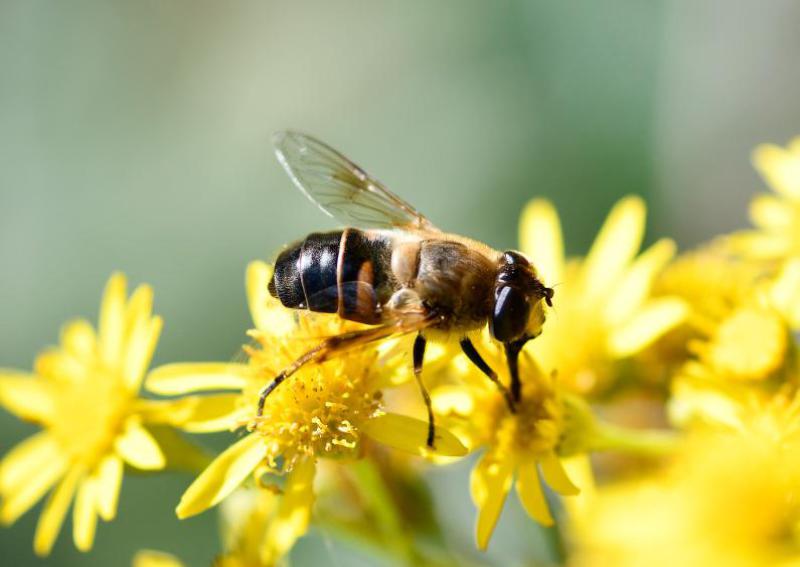
Common Drone Fly

The Common Drone Fly looks like a bee and has a name that suggests that it's a fly. However, it is a hoverfly!

Species introduction

At a glance
Latin name: 
Eristalis tenax
Family: 
Hoverflies
Family Latin name: 
SYRPHIDAE
Category: 
Insects other

Species description

Species description

The Common Drone Fly looks like a bee and has a name that suggests that it's a fly. However, it is a hoverfly! It resembles a bee drone (hence the name). This mimicry helps to protect it from predators. Like bees, these insects are pollinators.

Look closely and you'll not see the two pairs of wings that bees have, nor the 'waist' typical of bees, nor the stinger.

It can be identified by the orange markings on its abdomen, although these can vary substantially, and by the curve of its rear tibia.

Species photographs

Larger photograph(s) (click to magnify)

Details

Species family information

True to their name, the hoverflies hover around flowers, and then alight to feed on nectar and pollen. They are very important pollinators, and despite the fact that some look like wasps or bees, this is just mimicry and helps to keep potential predators at bay. Hoverflies have no sting, and have short, drooping antennae. The larvae are as useful as the adults, in that they feed on aphids. We have a photograph-filled blog post about all the hoverflies that we have seen in the Cemetery that may be worth your time.

Category information

Insects evolved in the Ordovician from a crustacean ancestral lineage as terrestrial invertebrates with six legs (the Hexapoda). This was the time when terrestrial plants first appeared. In the Devonian some insects developed wings and flight, the first animals to do so. An early flying group was the Odonata from the Carboniferous, the damselflies and dragonflies, which have densely-veined wings and long, ten-segmented bodies. They are day-flying carnivores, with an aquatic larval stage, so are commonly seen flying near water. The carnivorous larvae are called nymphs. Odonata species are short-lived, damselflies surviving for 2-4 weeks, dragonflies for up to 2 months.

Some insect groups in the Cretaceous co-evolved with the flowering plants, and they have had a close association ever since. These groups are the Hymenoptera (bees, wasps, and ants), the Lepidoptera (butterflies and moths), the Diptera (flies), and the Coleoptera (beetles). The diversity of beetles is astonishing. Of all the known animal species on the planet, one in five is a beetle!