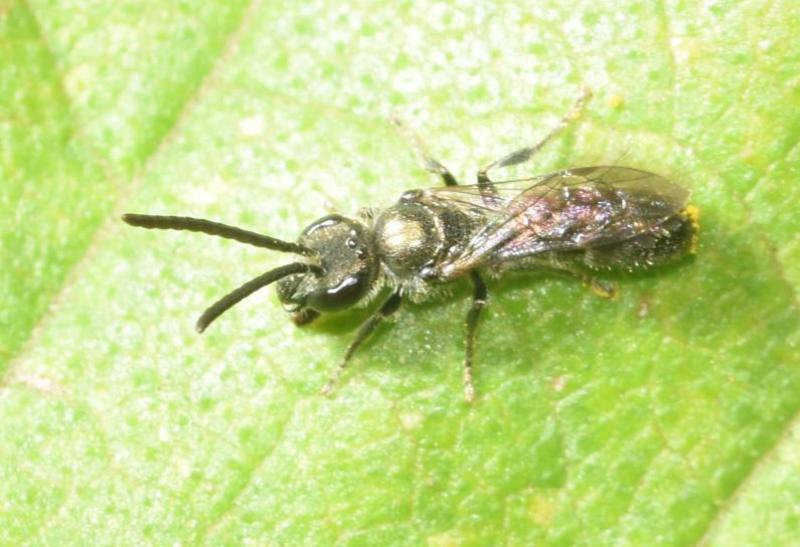
Green Furrow Bee

The Green Furrow Bee is a small (4 millimetres from wing tip to wing tip) bee.

Species introduction

At a glance
Latin name: 
Lasioglossum morio
Family: 
Sweat bees
Family Latin name: 
HALICTIDAE
Category: 
Insects other

Species description

Species description

The Green Furrow Bee is a small (4 millimetres from wing tip to wing tip) bee. Females fly from March to October, whereas males fly from June to October. This is the most frequent member of the various Lasioglossum family to visit gardens. They are 'eusocial', meaning that they share roles in a co-operative fashion, rather than being solitary. Compared to other Lasioglossum bees, L. morio has a dull-coloured thorax

Species photographs

Larger photograph(s) (click to magnify)

Details

Species family information

Halictic bees are called either End-banded Furrow Bees or Sweat Bees, the latter in recognition of the fact that they drink perspiration. This family of bees is the second-largest wild bee family. They are a diverse group, varying in appearance. Typically, these bees mass-provision their young with pollen and nectar, rather than doing so progressively.

Category information

Insects evolved in the Ordovician from a crustacean ancestral lineage as terrestrial invertebrates with six legs (the Hexapoda). This was the time when terrestrial plants first appeared. In the Devonian some insects developed wings and flight, the first animals to do so. An early flying group was the Odonata from the Carboniferous, the damselflies and dragonflies, which have densely-veined wings and long, ten-segmented bodies. They are day-flying carnivores, with an aquatic larval stage, so are commonly seen flying near water. The carnivorous larvae are called nymphs. Odonata species are short-lived, damselflies surviving for 2-4 weeks, dragonflies for up to 2 months.

Some insect groups in the Cretaceous co-evolved with the flowering plants, and they have had a close association ever since. These groups are the Hymenoptera (bees, wasps, and ants), the Lepidoptera (butterflies and moths), the Diptera (flies), and the Coleoptera (beetles). The diversity of beetles is astonishing. Of all the known animal species on the planet, one in five is a beetle!