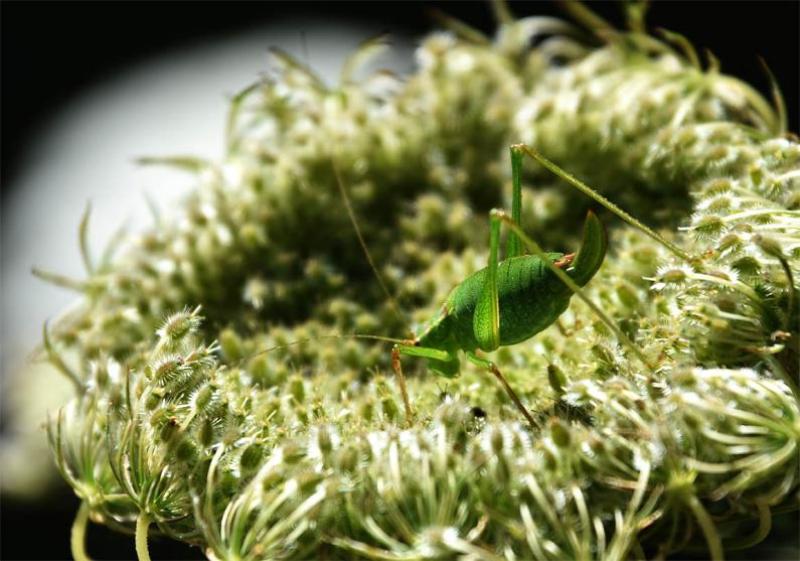
Speckled Bush-cricket

The Speckled Bush-cricket is generally secretive, but may be found from April to November.

Species introduction

At a glance
Latin name: 
Leptophyes punctatissima
Family: 
Bush Crickets
Family Latin name: 
TETTIGONIIDAE
Category: 
Insects other

Species description

Species description

The Speckled Bush-cricket is a flightless species, green with minute black speckles, and an orange-brown stripe along the back.  It is generally secretive, but may be found from April to November.

The Auditory system of Bush-crickets

Bush-crickets have outer, middle and inner ear components distributed across their anatomy. A single ear just below the knee on each foreleg connects to two drum-like (tympanic) membranes. These connect to a narrow cylindrical tube (an acoustic trachea) that runs internally along the leg, emerging on the side of the body just below/behind the shield that covers the join between the insect's head and the thorax, the pronotum. The eardrums inside the forelegs, therefore, receive sound from two sources. This allows the insect to assess differences in pressure and time between their left and right sides, aiding the creature's directional hearing.

One rarely sees the outer ears of these creatures. However, in this photograph (courtesy of Stuart MA Ball), the outer ear, the acoustic spiracle, can be seen very clearly:

Speckled Bush-cricket, Heene Cemetery, late August 2025, clearly showing the outer ear. (Photo credit: Stuart MA Ball.)
Speckled Bush-cricket, Heene Cemetery, late August 2025, clearly showing the outer ear, the acoustic spiracle. (Photo credit: Stuart MA Ball.)

As auditory communication between individual bush-crickets plays such an important part in their short lives, this degree of sophistication in their hearing should not surprise us. It's a degree of sophistication that is not unusual for mammals, but in the insect world, it is unique to bush-crickets. Grasshoppers lack this specific adaptation, possibly because they are exclusively herbivorous and don't eat other insects (as bush-crickets do).

Species photographs

Larger photograph(s) (click to magnify)

Details

Species family information

Bush-crickets are a large family that includes the bush-crickets and katydids, formerly called the long-horned grasshoppers. Although Bush-crickets and Grasshoppers are related, there are distinct differences between the two families. Crickets stridulate by rubbing their wings together at dusk, their 'ears' being on their front legs. (In contrast, Grasshoppers stridulate by rubbing their hind legs against their wings, their 'ears' being at the base of their abdomen.) Whereas Grasshoppers are mostly herbivores, Crickets are omnivores. Bush-crickets have long, thin antennae (in contrast to the shorter, stockier ones that Grasshoppers have). 

We have a photograph-filled blog post about all the grasshoppers and bush-crickets that we have seen in the Cemetery that may be worth your time.

Category information

Insects evolved in the Ordovician from a crustacean ancestral lineage as terrestrial invertebrates with six legs (the Hexapoda). This was the time when terrestrial plants first appeared. In the Devonian some insects developed wings and flight, the first animals to do so. An early flying group was the Odonata from the Carboniferous, the damselflies and dragonflies, which have densely-veined wings and long, ten-segmented bodies. They are day-flying carnivores, with an aquatic larval stage, so are commonly seen flying near water. The carnivorous larvae are called nymphs. Odonata species are short-lived, damselflies surviving for 2-4 weeks, dragonflies for up to 2 months.

Some insect groups in the Cretaceous co-evolved with the flowering plants, and they have had a close association ever since. These groups are the Hymenoptera (bees, wasps, and ants), the Lepidoptera (butterflies and moths), the Diptera (flies), and the Coleoptera (beetles). The diversity of beetles is astonishing. Of all the known animal species on the planet, one in five is a beetle!