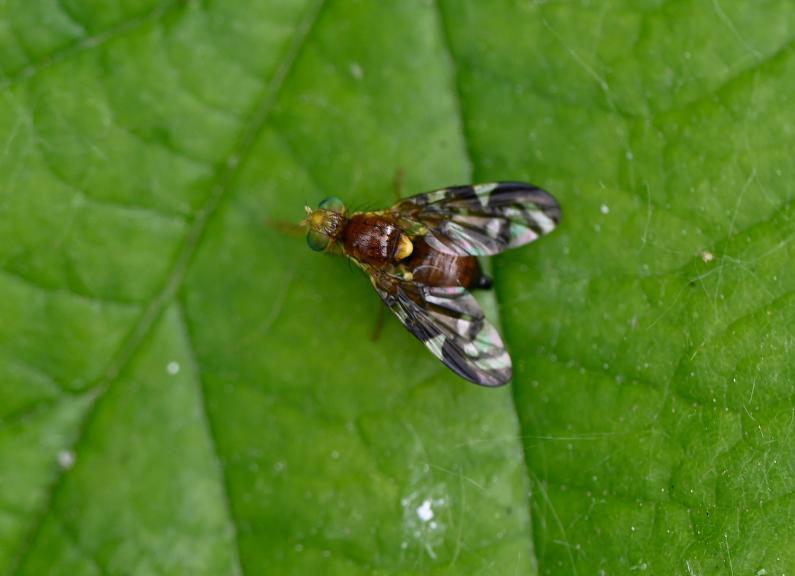
Celery Fly

These small flies have interesting black-and-clear wing patterns, brown bodies and green eyes.

Species introduction

At a glance
Latin name: 
Euleia heraclei
Family: 
Peacock flies
Family Latin name: 
Tephritidae
Category: 
Insects other
Vernacular names: 

Hogweed Picture-wing Fly

Species description

Species description

Celery Fly (Euleia heraclei) has a body length of between 5 and 7 millimetres.

These small flies have interesting black-and-clear wing patterns, brown bodies and green eyes. They principally feed on Celery and Parsnip plants, eating their leaves, but are also known to feed on Hogweed, of which there was a surprising supply when this insect was spotted (May 2025).

These insects are frequent and widespread in Britain.

Species photographs

Larger photograph(s) (click to magnify)

Details

Species family information

The Tephritidae is one of two families commonly called fruit flies. The Drosophilidae family are the 'common fruit flies' (used extensively in laboratories for genetic research), but these Tephritidae are sometimes called Peacock flies to distinguish them from their more famous relatives. As a rule, members of this family of flies have elaborate and colourful wing markings. Females lay eggs in living, healthy plant tissue, which the larvae feed on upon emerging. Adults have a short lifespan, often of less than a week.

Category information

Insects evolved in the Ordovician from a crustacean ancestral lineage as terrestrial invertebrates with six legs (the Hexapoda). This was the time when terrestrial plants first appeared. In the Devonian some insects developed wings and flight, the first animals to do so. An early flying group was the Odonata from the Carboniferous, the damselflies and dragonflies, which have densely-veined wings and long, ten-segmented bodies. They are day-flying carnivores, with an aquatic larval stage, so are commonly seen flying near water. The carnivorous larvae are called nymphs. Odonata species are short-lived, damselflies surviving for 2-4 weeks, dragonflies for up to 2 months.

Some insect groups in the Cretaceous co-evolved with the flowering plants, and they have had a close association ever since. These groups are the Hymenoptera (bees, wasps, and ants), the Lepidoptera (butterflies and moths), the Diptera (flies), and the Coleoptera (beetles). The diversity of beetles is astonishing. Of all the known animal species on the planet, one in five is a beetle!