The term species surveying sounds dry and dusty, conjuring up clipboards and lists. Imagine butterfly nets being swept through long grasses by Victorians wearing tweeds, plus fours and bush hats. Those were the days! More likely it consists of subject specialists involved in patient, detailed observation; Heene Cemetery has benefitted from a lot of that. Botanists and specialists in lichen, moss and fungi have indeed given generously of their time and expertise, an ornithologist too. Yet the project has mostly been a citizen science one, driven forward by enthusiastic amateurs supported, often off site, by real experts who’ve never set foot in the Cemetery. The tale of how this works is worth telling.
Long before the Friends of Heene Cemetery had a website to display their species ‘lists’ there were historic records. Not many in total, but they consisted of a citation from 1992 with a list of about 20 plants and birds, and by 2020 simple spreadsheets embraced some 300 species.
When the specification for the group’s first website was drawn up in 2019, it was decided to list the Cemetery’s species pictorially. A page for each species with text and images was the aim, but key was to use photographs taken in the Cemetery, not from stock libraries. This became both challenge and opportunity: challenge to find everything on the list and subsequently to identify anything we photographed that was not on the list, and opportunity to build a narrative around constantly climbing species numbers in this small, town-centre Sussex Local Wildlife Site.
Knepp just north of Worthing has reputation and heft. It is justifiably celebrated for the work done there that has turbocharged its biodiversity. Scores of subject specialists are on site surveying their species. How else could one uncover, for example, 1,800 invertebrate or 589 beetle species? Heene Cemetery’s much more modest approach has had to be very different.
Lacking repeat visits by scientists set on bio-blitzing with nets and ‘pooters’ that pull creatures off plants and into collecting chambers, at Heene camera is king. Instead of experts with microscopes, we have amateurs with cameras — and a shelf of field guides. When we can’t identify what we’re looking at, we reach out to subject specialists who might.
Since those early days, a network of over 20 specialists has been established. Each has their own often narrow field of expertise (bees, wasps, mosses, fungi, butterflies, moths, plants, spiders, slugs and snails, even leafhoppers). Many are county recorders co-ordinated by the Sussex Biodiversity Record Centre near Henfield. All share their time freely and generously. What they can’t do is guarantee to always identify something from a photograph!
Occasionally we are encouraged to capture an insect and fridge-chill it overnight before mailing it for microscopic examination. That would no doubt yield an ID. Yet more than a secure and validated species ID, we want no killing. Instead, there should be a high quality photograph in situ that reveals the creature as it is: wild, uncaptured, feeding, pollinating, and even mating, on one of its preferred plants— alive and 100% natural. We’ve always wanted to record and show these in their world, not in ours.
This type of mini photographic safari involves much loitering and prowling. Wind or even a stiff breeze results in rejected streaks and blurs. But since those early years, the verified species tally has gradually climbed (at the time of writing) to 763 *. Around 25 species have escaped observation, and nearly 50 lichens which have been scientifically named are represented only by stock images. The rest are on the group’s website as they were found — in situ.
Exceptions to the no-collecting rule have been when mist nests and a moth trap have been used to collect, ring (for birds) and release. Everything else has been witnessed untouched. The unobtrusive camera’s eye reveals much.
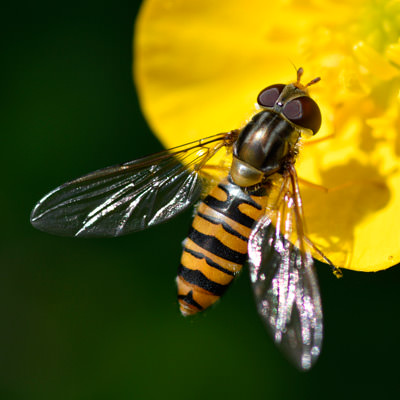
Sometimes what one finds is easy to identify. The female Patchwork Leafcutter Bee is the only leafcutter with an orange abdominal halo when seen from above. The exquisite Marmalade Hoverfly is the only one of our 286 hoverflies that has a black pencil line parallel to its wider black abdominal bands. Even with the naked eye, anyone can spot these characteristics.
We rejected thousands of photographs; others drew a blank with the specialists. Yet those that were verified show close-up part of the natural world on our doorstep before it is lost forever if we collectively don’t rise to the challenge of being champions for nature.
|
Patchwork Leafcutter Bee |
Marmalade Hoverfly |
For more information |
 |
 |
|
|
Flight period: May until late September Behaviour: busy performing handstands on flowers like Knapweed, collecting pollen with their orange abdominal hairs |
Flight period: May to September, even midwinter Behaviour: seeks nectar from a wide variety of flowers, especially yellow and white ones |
* (Since this article was first published, the number of species recorded in the Cemetery has risen to 773.)
[This article first appear in the August edition of Inside Worthing Magazine (page 16).]
Written by Rob Tomlinson